How a Dual Degree and a Big Idea Built a Better Air Purifier
Austin Riesenberger ’24 knew he was onto something big when, in his senior year, he innovated a new type of energy recovery ventilator, commonly called ERV, that is smaller, cheaper, and more efficient.
ERVs are ventilators that bring fresh outdoor air into a building while removing stale indoor air, all while transferring heat and humidity between the two to improve energy efficiency and indoor air quality. Unlike air purifiers, ERVs can also filter smaller particles that are bad to breathe in, as well as gases such as CO2 and radon.
But traditional ERV units, Riesenberger says, are gigantic, costly, and cumbersome, often putting them out of reach for average homeowners or renters.
So when he successfully developed a unit that would allow users to get clean air into their homes without spending thousands of dollars or cutting into walls, he knew he had the makings of a much-needed business—a business he now calls SWERV, named after his innovative ERV product.
“I was so excited when the first person expressed interest in buying one of these ERVs I made, that it made me want to work even harder and gave me even more motivation and clarity to see what this could become,” Riesenberger says.
Riesenberger, who studied mechanical engineering and graduated from St. Lawrence as well as from Columbia University through an innovative 3+2 partnership program, was so confident in his product that he declined attractive job offers to focus on it full time.
“At first I accepted a job in HVAC sales, and then received another offer for a similar role, but ultimately turned them down since I was spending all my time trying to turn my product into a business,” he says.
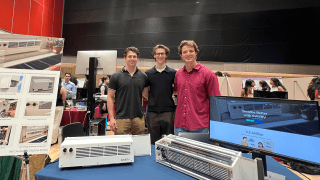
The prototype started as a senior design project at Columbia, where Riesenberger was helped by fellow Columbia alum Nick Walker as well as St. Lawrence and Columbia 3+2 program graduate Cole Ames ’24.
Ames, who recently landed a job at SpaceX as a propulsion engineer, says he was mainly involved in the conception of SWERV at Columbia, where he helped with the mechanical design and thermal efficiency.
Ames says he learned those skills in part from his last year at St. Lawrence, where he worked on an atmospheric water generator with Associate Professor of Physics Munir Pirbhai.
“Dr. Pirbhai was so helpful, and I learned a lot from him that I incorporated with SWERV,” Ames says, adding that the physics professors he had at St. Lawrence proved extremely useful with his work for SWERV, as well as with his current job.
At this point, Riesenberger says, he’s manufactured five SWERV prototypes by hand that he’s sold to beta-testers. But he hopes to ramp up operations and help purify homes across the country soon.
Learn More About St. Lawrence's Pre-Professional and Dual Degree Programs
Pre-Professional and Dual Degree Programs