
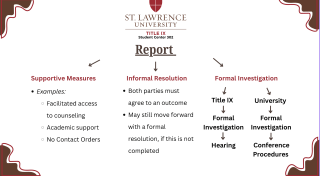
Formal Reporting Options: Decision Tree
Here you will find information on how to make a report.
Reporting Options
These reports are NOT reported to other University officials in any personally identifiable manner. If you want a university response, ask the resource to connect you with the Title IX Coordinator.
On-Campus
The Advocates 315-229-5466
University Chaplain
Shaun Whitehead
315-229-5062
Health and Counseling Center
315-229-5392
Director of Wellness Education
Laura Lavoie
315-229-5757
International Student Services Staff
Tsewang Lama, Director of International Student Services
315-229-5552
Megan Putney, Assistant Director of International Student Services
315-229-5141
Off-Campus
Canton-Potsdam Hospital
315-265-3300
Renewal House
3 Chapel Street
M-F 8:00am-5:00pm
315-379-9845
Renewal House also has an advocate on-campus Fridays 8am-4pm in Bewkes 315. An email for that advocate is: renewalhouse_campus@verizon.net
Supportive measures are ways the university can help restore or preserve, to the extent practicable, equal access to the University’s educational programs and activities and protect the safety of all parties without unreasonably burdening the other party or parties
Supportive measures may include, as appropriate, but are not limited to:
- Changes in academics such as the extension of deadlines or other course-related adjustments
- Changes to housing, transportation and campus working situations if those changes are requested by a party and reasonably available
- Class schedule modifications, withdrawals, or leaves of absence
- Changes in class registration process
- Education to the institutional community or community subgroup(s)
- Allowing withdrawal from or retaking of classes without penalty
- Prohibiting attendance at group or organizational functions overseen by the University
- Mutual “No Contact” orders and, in limited circumstances, one-way no contact orders.
- Access to safe walks and campus escorts or other reasonable security or monitoring measures
- Facilitated access to counseling services
- Facilitated access to the Employee Assistance Program
- Interim removal of a student from the University, which will only be taken pursuant to the Emergency Removal provisions above.
Informal resolutions provide both parties with an opportunity to understand each other’s concerns and address them as collaboratively and usefully for the parties as possible. An informal resolution can occur when a formal complaint is filed and both parties agree, in writing, to move forward. A conclusion is only reached when both parties agree, and after a written resolution is finalized both parties must sign the document.
The University makes a good faith effort to conclude an Informal Resolution in 5-30 days.
*Note* A Formal complaint is necessary to initiate the University’s Informal Resolution or Formal Investigation and Adjudication process. A Formal complaint must be submitted in writing and request that the University investigate the allegation(s).*
When a formal investigation is chosen, the Title IX Coordinator will promptly provide a written Notice of Investigation and Allegation to both parties. The University presumes the Respondent is not responsible until there is a finding of Responsibility at the conclusion of the Formal Investigation and Adjudication.
Formal Investigations include interviews of parties and witnesses, opportunity to review all evidence and transcripts gathered, opportunity to respond to evidence, and conclude with a hearing (Title IX) or conference (non-Title IX) before a determination is made.
Hearing- A Hearing is typically 6-20 hours over many days, and is used for Title IX Formal Complaints. Hearings are held virtually. The parties are only permitted to bring their advisor to the virtual hearing. Either party may request an in-person hearing. In order for such a request to be granted, both parties, the Review Board, and the Title IX Coordinator must agree. If there is no such agreement then the hearing will be held virtually, as described in this paragraph.
Generally, the hearing will proceed in the following order:
1. Opportunity for Opening Statement by the Complainant
2. Opportunity for Opening Statement by the Respondent
3. Questions for the Complainant by the RB, and, if desired, on behalf of the Respondent’s advisor, followed by an opportunity for a clarifying statement
4. Questions for the Respondent by the RB, and, if desired, on behalf of the Complainant’s advisor, followed by an opportunity for a clarifying statement
5. Questions for each witness by the RB, and, if desired, on behalf of the Complainant and Respondent
6. Opportunity for Closing Statement by Complainant
7. Opportunity for Closing Statement by Respondent
*Anyone reporting sexual misconduct, including an incident of sexual harassment, sexual assault, domestic or dating violence, or stalking has the right to withdraw a formal complaint or involvement from the university process at any time, with the understanding that in certain cases the university may be required to proceed even if the reporting individual does not wish to do so.
Matters that fall under the University's Combined Discrimination and Harassment Policy and Procedures, but are not Title IX matters, will follow a University Formal Investigation and Adjudication process. Examples of matters that fall in this category include: sexual misconduct that falls outside Title IX jurisdiction, sexual exploitation, and discrimination or harassment related to one of the following protected characteristics:
race, color, national origin, religion, creed, age, disability, sex, gender identity or expression, sexual orientation, familial status, pregnancy, predisposing genetic characteristics, military status, domestic violence victim status, criminal conviction, or any other characteristic protected by applicable local, state, or federal law or regulation,
Conference- Only certain situations are available for conferences, anything that falls under federal Title IX law will undergo a Hearing. However, formal complaints that fall under the university's combined discrimination and harassment policy may be considered for a conference. There are no opening and closing statements, no direct cross-examination, and the review board asks all questions.
Conferences include the following:
1. Initial Relevance Determinations, as determined at the pre-conference, are put on the Record
2. Questions for the Complainant by the Adjudicators, including advisor submitted questions, if any
3. Opportunity for Respondent’s advisor to send Adjudicators follow-up questions, if desired.
4. Follow-up questions posed to the Complainant by the Adjudicators, where relevant and not otherwise impermissible, if any
5. Questions for the Respondent by the Adjudicators, including advisor submitted questions, if any
6. Opportunity for Complainant’s advisor to send Adjudicators follow-up questions, if desired.
7. Follow-up questions posed to the Respondent by the Adjudicators, where relevant and not otherwise impermissible, if any
8. Questions for each witness by the Adjudicators, including advisor submitted questions, if any
9. Opportunity for both advisors to send Adjudicators follow-up questions, if desired.
10. Follow-up questions posed to the witness by the Adjudicators, where relevant and not otherwise impermissible, if any.
The University protects individuals' privacy in reports or complaints while distinguishing between privacy and confidentiality. Privacy means information is shared only with those who need to know for assignment, investigation, or resolution. Confidentiality applies to certain professionals (medical providers, metal health counselors, clergy) who cannot disclose information without permission, except in specific legal or safety situations. While the University prioritizes pricey, it may contact parents/guardians in case of significant health or safety risks, usually after consulting the student.
FAQ's
Here you will find answers to students frequently asked questions regarding reporting.
You have many options when submitting a report:
- You can report via an online form here
- *Anonymous reports are accepted, however SLU may not be able to move forward with an investigation without names
- You can share with a mandatory reporter who will report to the Title IX Coordinator. All non-student employees who are not confidential are mandatory reporters
- You can go straight to the Title IX Coordinator
- Heather Ventresco, Student Center Room 302 (by the massage chairs, hventresco@stlawu.edu)
- After using any of the above resources, one can expect to receive outreach from the Title IX Coordinator. The Title IX Office prides itself on supporting individual’s agency throughout the entire process. After receiving the outreach, if the impacted person is not a threat to themselves or others, the impacted person will be free not to respond to the offer to meet. However, if you would like to move forward there are many options outlined in the flowchart above.
Students and employees always have the right to report to local law enforcement. However, by making a formal complaint to the Title IX Coordinator, you will be going through University or Title IX procedures, not local law procedures. A finding of responsibility will likely result in University consequences that may not always binding outside of University property.
No. There is no Formal Report in Title IX or University procedures. Anytime the Title IX Coordinator is given information that contains identifiable information a report has been made. When a report has been made, an investigation is only one of several possible options to follow.
A Formal Complaint is written and submitted to the Title IX Coordinator, with the intention of moving forward with either an Informal resolution or a Formal Investigation and Adjudication. The person submitting the Formal Complaint is moving forward out of their own desire to go through Title IX or University Investigations and Hearing/Conference Procedures.
No, you do not have to make a Formal Complaint when talking to the Title IX Coordinator. The Title IX Coordinator will help provide information about the process moving forward, including the option of a Formal Written Complaint. However, there are many reasons why one may not move forward with a Formal Complaint, which will be respected by the University. After speaking with the Title IX Coordinator, you may receive further outreach, checking in and providing resources.