
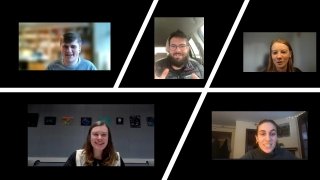
SLU biophysics alumni Sky Fuller, Cameron Brochu, Anna Foster, Cora Ferguson, and Victoria Cubina share where they’ve gone, what they’ve built, and why it all started here at SLU.
Thinking Like a Scientist (and an Engineer)
Cora Ferguson, now a PhD student in bioengineering at the University of Oregon, describes her SLU biophysics degree as “really useful” for one major reason: it taught her how to think. “It really taught me to look at problems from multiple angles: physical, biological, chemical, mathematical, and engineering,” she explained. Now working in a highly interdisciplinary lab with engineers and life scientists, she stands out for her ability to bring different frameworks to the table. “I provide feedback they otherwise wouldn’t think about,” she added.
Cameron Brochu echoed the value of this broad, interdisciplinary approach fostered by the program, which prepares students for diverse challenges. “A lot of my job is troubleshooting, poking through circuit boards, writing code for automated testing, collaborating with teams. I wouldn’t have been given that kind of responsibility if I didn’t already have experience with integrated coding and problem-solving, specifically gained in the physics labs at SLU.”
Communication Is a Science Too
St. Lawrence biophysics majors don’t just learn science; they learn how to communicate it too. Anna Foster emphasized this: “I still remember a lab assignment where we had to write a report explaining advanced physics to a family member. It felt weird at the time, but now I do that daily, explaining complex systems to doctors, nurses, and administrators. That one assignment helped me communicate across disciplines more clearly.”
Victoria Cubina, now pursuing a master’s in engineering, recalled that in her Physical Biology and Medicine course, students had to find real-world biophysics articles, understand them deeply, and present their insights to the class. “That class taught me how to find and evaluate information quickly. It helped me learn how to ask the right questions, assess sources, and explain scientific ideas clearly.”
Skills like clear communication, fast learning, and effective presentation are incredibly valuable in the workplace. Many employers assume new hires will struggle in these areas, which is why SLU alumni often stand out early in their careers. These essential communication skills, coupled with the personalized attention students receive, are just one way graduates of the biophysics program are set up for success.
Small Classes. Big Opportunities.
Another major advantage our alumni frequently cite is unparalleled access to faculty. At SLU, biophysics students aren’t anonymous faces in a lecture hall. Small class sizes mean you get to know your professors, and they get to know you.
Victoria described the impact: “The science classes at SLU made it really easy to build close relationships with professors. That mattered a lot later. My 3-2 program advisor has helped me navigate so many opportunities after graduation.” These relationships translate directly into career guidance, reference letters, and job connections.
And the connections don’t stop there. These close-knit academic environments often extend into a powerful alumni network. “One SLU alum helped me get my first job,” said Anna. “That alumni network is real.”
Hands-On and Real-World
SLU’s biophysics program is built around doing, building, and figuring things out. Cora recalled Modern Physics as the course that changed everything. “It was the first time we were given a task and told, ‘Here’s your equipment and your manuals, now figure it out.’ That experience prepared me for grad school more than anything else.”
In their Physical Biology and Medicine course, students used Arduinos and learned basic circuits, skills that gave one graduate an edge when writing code to automate testing of sensors.
For students on the 3-2 engineering track, the transition from SLU to schools like Dartmouth or Columbia felt surprisingly smooth. “I thought I’d feel behind, but I didn’t,” said one student. “The technical foundation from SLU held up, even at an Ivy.”
Career Flexibility
Here’s the truth: our biophysics grads are not all following the same path, and that is one of the program’s greatest strengths. Some go into biomedical research, like Anna, who trained pigs to run on treadmills and operated an MRI machine. Others, like Victoria, shifted into medical device design after exploring regenerative medicine. Cameron became a calibration technician straight out of undergrad and was quickly promoted to technical engineer. Another manages software upgrades, FDA recalls, and equipment safety incidents in a hospital while completing a clinical engineering master’s degree.
As Sky Fuller puts it, “I thought research was the only thing you could do with a biophysics degree. It’s not. You can go into data science, quality assurance, medical tech, engineering, clinical roles, there’s more out there than you think.”
That kind of career flexibility is rooted in the flexibility students experience at St. Lawrence. Unlike narrow technical programs, SLU’s liberal arts environment encourages exploration. You might take public speaking, philosophy, environmental studies, or even go abroad, all while pursuing a rigorous science degree. That breadth pays off. You’re not just a physics student or a biology student; you’re someone trained to make connections, communicate across disciplines, and pivot as your interests evolve. This is the true power of an SLU biophysics degree.
And if you’re still figuring things out? That’s okay. Some of our alumni were, too. As one graduate put it, “If you don’t know what you want to do yet, don’t stress. You’ve got 40 years to figure it out, and this degree gives you options.”
