St. Lawrence Students Build Innovative Greenhouse for Future Laurentians
When it’s finally complete, St. Lawrence’s new innovative greenhouse will be home to all sorts of plants, even tropical fruits and vegetables, in the deepest chill of winter.
It will also be a hands-on learning laboratory for classes and student and faculty research, and will be among the only greenhouses like it in the entire state.
But that won’t be for at least a couple more years. That’s because construction on the greenhouse is entirely student-led, and only happens during the fall semester as part of a practicum course in Environmental Studies led by Associate Professor Aaron Iverson, a course he’s been teaching since 2020.
The dozen or so students who eagerly take the course each fall know they won’t get to enjoy the fruits of their labor, but the hands-on work, and the desire to contribute to something that future generations of Laurentians will get to enjoy, make the class truly unique and beloved.
Hands-On Learning
Pierce Wilkerson ’27, who took the course last fall and majors in Environmental Studies and Sociology, says it is the most unique class he’s taken at St. Lawrence, and connects with his experience living in the Outing Club theme house on campus, which takes students on excursions and adventures across the North Country.
“I like working with my hands, and I feel that hands-on learning helps me understand the concepts we’re learning about better,” Pierce says. “Plus, to be outside working the whole time is pretty awesome.”
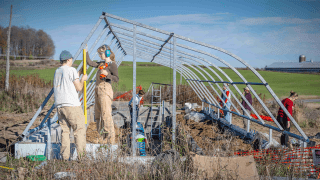
A professional contractor performed the excavation, and code enforcement officers had to give the final OK, but after that, the students took over.
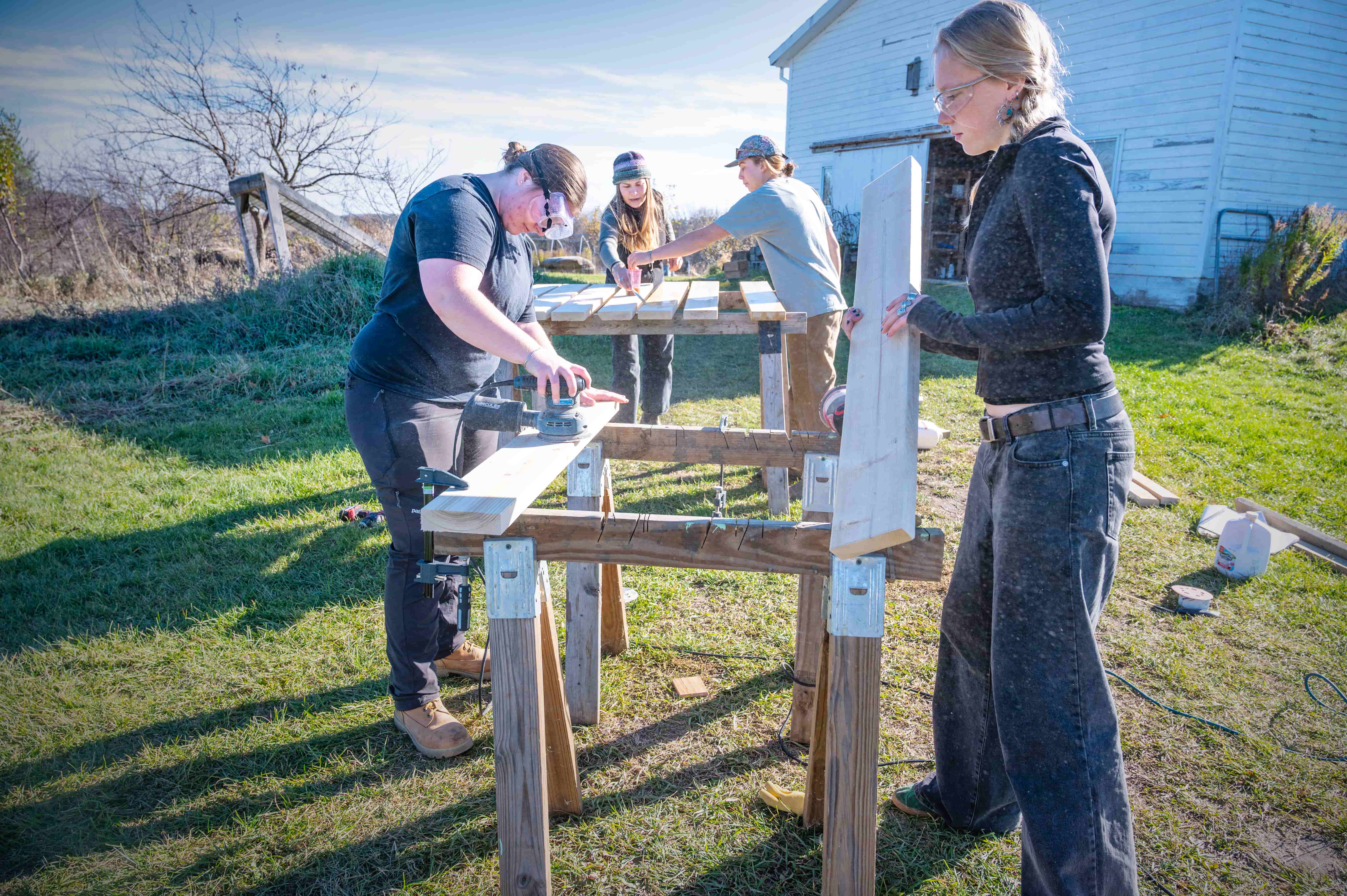
The first semester the class started, Iverson says, the students learned masonry and laid 1,000 bricks for the 16 x 60-foot foundation. The next semester, they put interior beds in the greenhouse. The semester after that, they put in metal support frames, and this past fall they built a boardwalk and prepped walls for window and door installation.
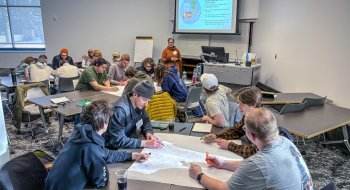
The course contains a lecture component on the theory of energy-efficient design, especially applied to greenhouses, as well as discussions on resilient local food systems. Then there’s the“lab” component, where Iverson and his students meet once per week for three hours to actually build the greenhouse.
And it’s not just any greenhouse.
Student-Led Innovation
“We’re incorporating a lot of principles of energy-efficient design,” Iverson says. The first, he explains, is that it’s partially underground, mitigating heat loss. It will also be equipped with a geothermal system, where underground tubes blow air (that’s 50F year-round) from one end to another, moderating temperatures across the seasons.
Then solar energy will be stored by the thermal-mass of barrels filled with water, which absorb warmer energy during the day and then radiate that out at night when it’s cooler. Also, nearly the entire greenhouse is insulated except the southside, where the sun enters.
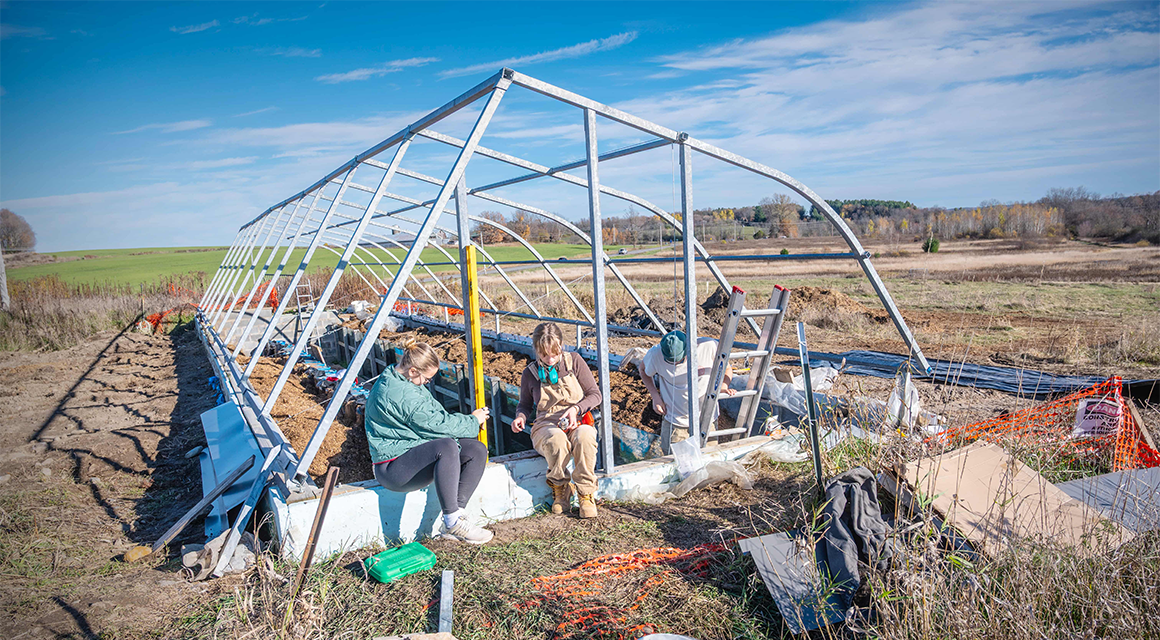
These techniques, Iverson says, will theoretically allow the greenhouse to grow tropical perennials all year long, even when it’s freezing out—for a fraction of the energy cost of a typical greenhouse.
“In addition to growing common annuals out-of-season, the plan is to have perennial plants that can’t be grown here in the North Country and which might have particular appeal either for the market or for education,” Iverson says.
Bringing the Tropics to SLU
Crop ideas include citrus items like lemons, limes, oranges, and even guava, pomegranates, passion fruit, and ginger. Iverson also hopes the greenhouse will be able to grow and give students the chance to experience globally important—but rare to see in upstate New York—crops such as cacao or coffee.
He thinks the greenhouse’s ability to grow these crops might encourage local farmers or gardeners to replicate this structure, as growing food during the winter months is typically impractical here simply due to energy costs of heating a typical greenhouse.
Iverson would like to test whether it can be a market opportunity in the North Country—similar structures in Nebraska, for instance, grow and sell citrus at an impressive profit margin—at a time of year when very little local produce is otherwise available. A major goal of the greenhouse is to determine how much food it can grow and what it could potentially contribute towards building a more resilient local food system.
Ultimately, Iverson says, the students will help with the process of deciding what crops to grow and how to use the greenhouse.
The Beautiful Living Lab
Getting to the building site for the class is also an adventure unto itself. The greenhouse is located on the St. Lawrence University Living Lab, a gorgeous 127-acre tract of land located on Route 68 within the village of Canton, less than one mile from the main campus.
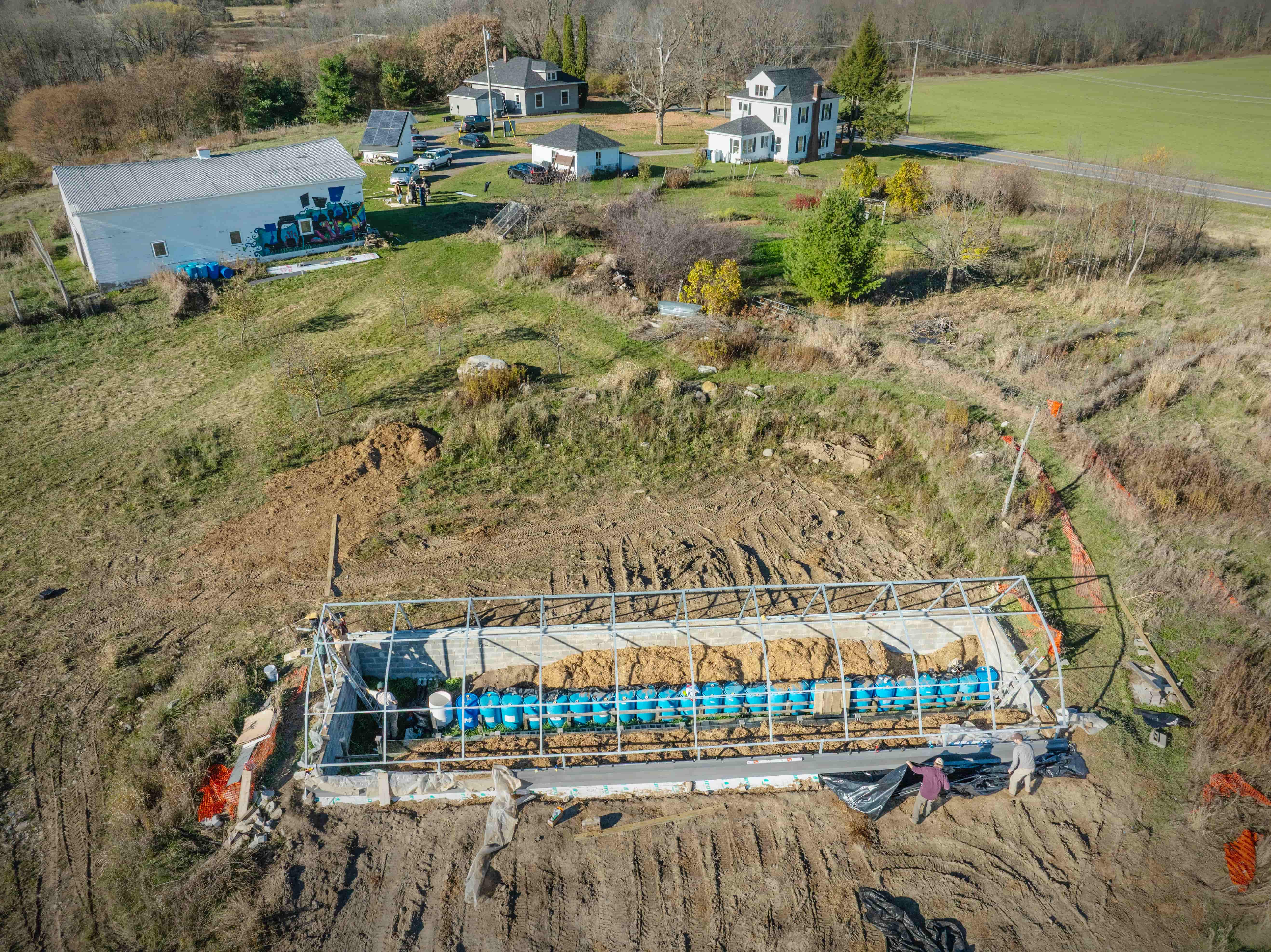
The site includes fields, forests, wetlands, and streams complete with a three-story house—the Wight House—outbuildings, and a small garden. Several courses that cover topics such as agroecology and renewable energy utilize this living laboratory over the course of the year.
When it’s warm enough, Iverson says most students bike along the beautiful Saddlemire Trail—that connects St. Lawrence’s campus to local scenery such as the Little River, tall grass fields, and a horse pasture—in order to reach the Living Lab and begin work on the greenhouse.
Despite being so close to campus, the site feels pastoral and remote. The ability to undertake coursework there, away from the hubbub of the main campus, is a unique feature of studying at St. Lawrence, and a major reason many students like taking the course.
Why Students Love It
“Being outside and making this place our classroom is such a unique opportunity,” says Doris van Zwetselaar ’28, who took the course this past fall. “The Living Lab is a hidden treasure, and I love the beautiful path you get to take to arrive here.”
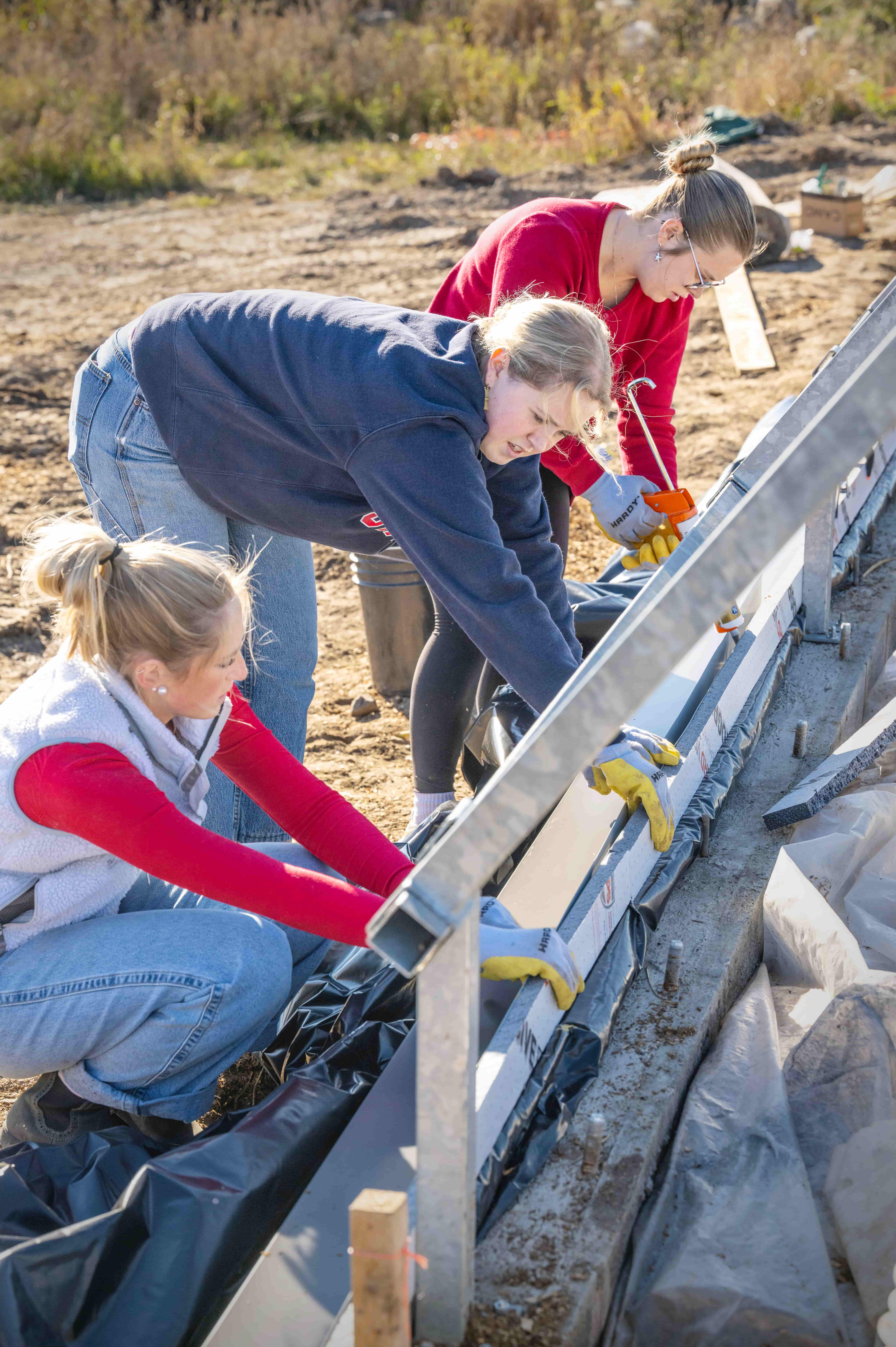
Doris, who’s pursuing Environmental Studies and Public Health and helped construct the main walkway inside the greenhouse, relishes the experiential learning aspect of the course. “Being able to apply what we’re learning in class to a real and useful construction is really valuable, and it’s nice to see the physical progress of our work.”
For Environmental Studies major Madalyn Bascom ’26, the appeal was being part of a project that will benefit future generations of students.
“It’s really rewarding to give back to St. Lawrence and to the students who will be here when I’m gone.”